
Market Matters – Markets wobble, earnings hold firm
September has a habit of testing investor confidence. With oil back above $100, stubborn inflation, rising bond yields and central banks leaning towards further tightening, this year is no exception. A modest equity pullback is hardly surprising. The more striking point is how well markets have held up. The S&P 500 is still close to its highs and comfortably up on the year, despite the 10-year Treasury yield briefly brushing 5% and Brent crude touching almost $110 during the week. There is certainly scope for more volatility as we move through September, but for now the underlying corporate picture remains considerably better than the headlines might suggest.
Markets Finally Wobble
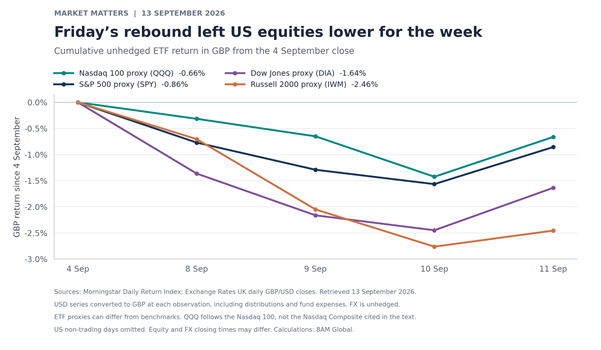
After several months in which equities seemed capable of shrugging off almost anything, last week produced a more familiar September feel. The S&P 500 finished the week 0.8% lower, the Nasdaq Composite slipped 0.7%, the Dow lost 1.6% and smaller companies were weaker again, with the Russell 2000 down 2.4%. Friday brought a decent rebound, but only after four consecutive losing trading sessions.
Europe was softer too: the FTSE 100 lost 1.7% over the week, the STOXX 600 1.7% and the DAX 1.8%. Hong Kong was one of the weakest major markets, with the Hang Seng down 3.3%. The index figures cover the week ending 11 September in local currencies. The chart below shows unhedged US ETF returns in sterling.
None of this looks particularly dramatic in isolation. The more important point is what caused it. Markets were forced to absorb a renewed surge in energy prices, firmer inflation data and another leg higher in bond yields at the same time. That is a difficult combination for equities, particularly when valuations have been elevated. Yet the pullback was still relatively contained. The market is wobbling rather than breaking.
A Valuation Correction Without a Market Correction
US equities have already become less expensive relative to expected earnings, even without a substantial market fall. The forward price/earnings ratio was around 19.2 times on Friday, its lowest for approximately 17 months. At the end of last year it was around 22 times. In other words, we have already seen a decline of approximately 13% in the valuation multiple without anything approaching a 10% fall in the index.
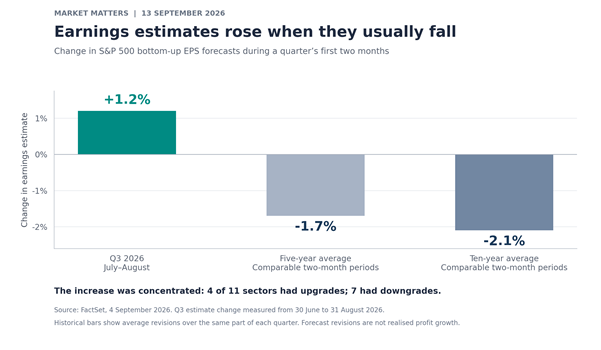
The reason, of course, is earnings—both those already delivered and those expected over the next twelve months. Earnings expectations have risen faster than share prices, bringing the forward multiple down. Those forecasts still need to be delivered, but the starting valuation is less demanding. Second-quarter earnings were exceptionally strong and estimates for the third quarter have continued to move higher, when normally analysts would be trimming forecasts at this stage. FactSet noted that the bottom-up Q3 earnings estimate actually rose 1.2% during July and August; historically, estimates tend to fall over the equivalent period.
The improvement has not been uniform: only four of the eleven sectors saw Q3 estimates rise, with energy leading the way. That is encouraging for aggregate earnings, but still leaves plenty of room for differences between sectors and individual companies.
Around 86% of S&P 500 companies beat earnings expectations in the second quarter, considerably above the long-term average. Investment gains at Alphabet and Amazon inflated some of the headline profit numbers. Even so, FactSet’s late-August assessment showed earnings growth of 31.8% for the companies outside the Magnificent Seven, so the strength was not confined to those accounting gains.
That’s pretty crucial – a market on 22 times earnings with bond yields rising towards 5% is uncomfortable. A market closer to 19 times, where earnings are still growing strongly, is a rather different proposition. Higher yields can certainly pressure valuations further, but a meaningful part of the adjustment has already occurred through earnings growth rather than falling share prices. That is one reason I would be wary of getting carried away with the more bearish September narratives.
Oil Returns to Centre Stage
The clearest new problem is oil. Brent settled at $104.61 a barrel on Friday, up 8.7% over the week despite a 2.8% retreat that day as hopes of talks offered some relief. It had traded close to $110 at one point. Once again, the issue is not simply the absolute oil price but the vulnerability of the supply routes. The conflict around the Strait of Hormuz has severely restricted flows through one of the world’s most important energy arteries, while Houthi advances and attacks on Saudi infrastructure have now added concerns around the Red Sea and Bab el-Mandeb.
The situation has continued to develop over the weekend. Saudi Arabia has temporarily closed its East-West pipeline as a precaution following drone attacks, although the duration and effect on exports remain unclear. That puts an important alternative to Hormuz under pressure. There has also been a further reported incident involving a vessel in the Strait itself. Iran says talks are planned in Oman on Monday, but an immediate signed agreement is not expected. Friday’s market prices do not capture these weekend developments.
Oil at $100-$110 is not necessarily enough to derail the global economy, but it changes the inflation arithmetic. It acts as a tax on consumers, increases transportation and manufacturing costs and, perhaps most importantly for markets, makes it much harder for central banks to declare victory over inflation. The longer oil remains elevated, the greater the chance that what initially looks like a one-off energy shock begins to find its way into wages and broader prices.
Copper offered another reminder that commodity strength needs interpreting carefully. Prices reached records partly on tariff-related stockpiling, then reversed sharply as doubts emerged over the proposed US duties. Higher commodity prices do not always tell us that underlying demand is getting stronger.
Inflation, Yields and the Fed
That concern was reinforced by the latest US inflation numbers. Headline CPI rose 0.4% in August and remained at 3.4% year-on-year, while core prices increased 0.3% on the month. There was some encouragement beneath the headline: annual core inflation eased to 2.4% from 2.5%. The difficulty is that the firmer monthly reading and renewed energy pressure make it harder to assume that this progress will continue.
Producer prices also rose 0.4% in August and 5.4% over the year, underlining the cost pressure further up the supply chain. The CPI numbers were not disastrous and were close enough to expectations to allow equities to rally on Friday, but they did little to support the case for lower interest rates. Markets ended the week assigning a high probability to the Federal Reserve raising rates at this week’s meeting.
The bond market has already done a considerable amount of tightening on the Fed’s behalf. The US 10-year Treasury yield briefly reached almost 5% before easing back. That level matters. At 5%, government bonds become a genuine competitor for capital and the discount rate applied to future corporate earnings rises materially. Long yields are also being driven by more than simply the next Fed decision. Large fiscal deficits, heavy government and corporate issuance and concerns over the longer-term inflation outlook are all contributing to higher borrowing costs.
For multi-asset portfolios, an inflation-driven rise in yields can hurt bonds and equities together. How much interest-rate risk sits in the bond allocation matters as much as its size.
This remains the biggest near-term challenge for equities. We can probably live with oil above $100 if it proves temporary. We can live with a quarter-point Fed hike if it is presented as a piece of insurance rather than the beginning of a new tightening cycle. What would be more difficult is a sustained move in the 10-year yield decisively above 5%, particularly if markets start anticipating a succession of rate increases. For the moment that is not my base case, but it is probably the number I am watching most closely.
Europe has already announced its move. The ECB agreed a 25-basis-point increase in its deposit rate to 2.5%, effective from 16 September, its second increase this year. The move followed an energy shock that helped push euro-zone inflation back above 3%.
The Bank of England meets this week and is expected to hold at 3.75%. Higher oil and a surprisingly resilient UK economy have made near-term rate cuts much harder to justify. UK GDP grew 0.4% in July, stronger than expected. Good news fundamentally, although perhaps not what anyone hoping for cheaper money wanted to hear.
The detail was less uniformly strong: consumer-facing services fell 0.4% in July. The economy is proving resilient overall, but that does not yet amount to a convincing recovery in household spending, particularly with the latest energy increase still to feed through.
AI Demand Has Not Gone Away
If the macro backdrop was the uncomfortable part of the week, Oracle provided a useful reminder of why equity markets have remained so resilient. Its numbers were extraordinary. Quarterly revenue rose 30% to $19.3 billion, cloud revenue increased 62% to $11.6 billion and cloud infrastructure revenue jumped 121% to $7.4 billion. Remaining performance obligations reached $664 billion, up $209 billion from a year earlier, while Oracle booked more than $30 billion of additional AI cloud contracts during the quarter.
Those numbers matter well beyond Oracle. We spend plenty of time questioning whether the extraordinary sums being committed to AI infrastructure will ultimately earn an adequate return, and I think that remains one of the central investment questions of the next few years. What is much harder to argue at present is that demand is weakening. Oracle says demand for AI training and inference capacity is still growing faster than supply and added another 850 megawatts of data-centre capacity during the quarter.
The evidence is not confined to Oracle. TSMC’s August revenue rose 53.3% from a year earlier and 10.1% from July. Those figures cover its whole business, but provide another strong indication that demand across the semiconductor supply chain remains robust.
The financing side deserves just as much attention. Oracle spent $28.5 billion on capital expenditure during the quarter and reported around $5 billion of negative free cash flow. Customer prepayments of $11.36 billion helped fund the expansion, alongside $20 billion of equity issuance.
Prepayments can reduce Oracle’s direct funding requirement, but they do not make the capital bill disappear. Its $664 billion backlog represents future contracted revenue. The questions are how quickly those contracts convert into profitable delivery, and who bears the risk if the expected returns fail to materialise.
For now, however, Oracle joins Nvidia, Broadcom and others in providing another fairly emphatic piece of evidence that the AI infrastructure build-out remains in full swing. That continues to feed through into earnings across technology, semiconductors, electrical equipment, power infrastructure and an increasingly broad range of industrial companies.
Strong demand does not mean the competitive landscape stands still. Amazon’s new arrangement with Qualcomm expands its potential chip-supply options. That may improve customers’ economics, while making the distribution of future profits between chip suppliers rather less certain.
Apple also provided a different test of technology demand with its first foldable iPhone, starting at $1,999. It does not reach customers until October, so the next question is whether households will pay for the upgrade. The launch is an opportunity; orders and margins will tell us how valuable it becomes.
Japan – One to Watch
Japan is also becoming more important again. The yen strengthened sharply, while positioning data for the week to 8 September showed speculators net long for the first time since February. The Bank of Japan is widely expected to raise rates by 25 basis points this week to 1.25%, which would be the highest level for more than three decades.
With a quarter-point hike already widely anticipated, the greater risk may lie in unexpectedly hawkish guidance or another rapid move in the yen.
Ordinarily a 1.25% interest rate would hardly sound threatening, but Japan has been the world’s cheap funding currency for years. Rising Japanese rates combined with a stronger yen can force investors to unwind carry trades, which is why apparently modest changes in Japanese monetary policy can occasionally produce disproportionate volatility elsewhere. With global bond markets already unsettled, it is another moving part worth keeping an eye on.
This Week…
Three central-bank decisions make this a significant week. The Federal Reserve announces its decision and economic projections on Wednesday 16 September, with markets now leaning heavily towards a quarter-point hike. UK inflation data arrive earlier that day. The Bank of England meets on Thursday 17 September and should leave rates unchanged, while the Bank of Japan is expected to tighten on Friday 18 September. With tightening already anticipated in the US and Japan, the guidance on what follows may matter as much as this week’s decisions. Overlay all of that with a highly unstable oil market and continuing negotiations around Hormuz and there is plenty of scope for another volatile week.
September’s risks are clear, but so is the counterweight: strong earnings and a less demanding forward valuation.
I remain constructive, while recognising that the path is unlikely to be smooth. A further correction would not be surprising if the US 10-year yield moves sustainably above 5% or oil pushes materially higher. Strong profits provide support, but equities can still fall if investors demand a higher return for holding them. For now, this looks more like a valuation and positioning adjustment than a broader deterioration in corporate fundamentals. If financing conditions stabilise and earnings hold up, there is still a credible path to a stronger finish to the year.
DOWNLOADS
There are currently no downloads associated with this article.