
Out of September, Not Out of the Woods
September is finally behind us and, after a month in which almost every piece of good economic news seemed to be accompanied by another rise in bond yields, investors might be forgiven for feeling slightly relieved. It was not a disastrous month in the conventional sense, particularly if your main reference point remains the S&P 500, but underneath the surface there was a considerable amount going on. Our chart below, which runs from the end of August through the first couple of days of October, shows the divergence rather neatly. The S&P 500 just about kept its head above water, emerging markets and Asia were broadly flat and Japan slipped only modestly, while bonds weakened, European and UK equities came under more pressure and China was the clear laggard. It was a useful reminder that a headline US index increasingly tells us only part of the story.
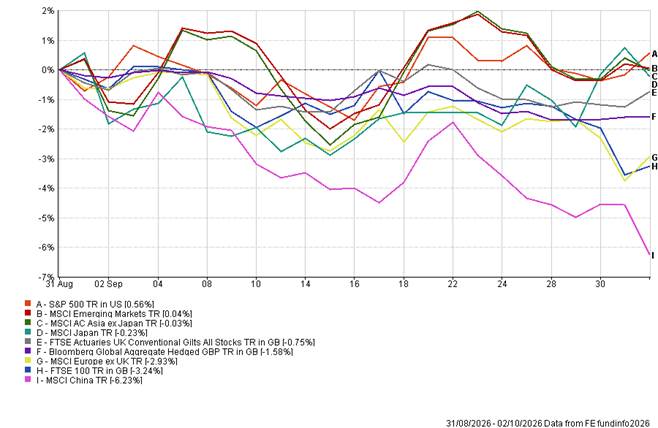
Total returns, 31 August–2 October 2026. Equities are shown in local currency; gilts are in sterling and global aggregate bonds are sterling hedged. Source: FE Fundinfo.
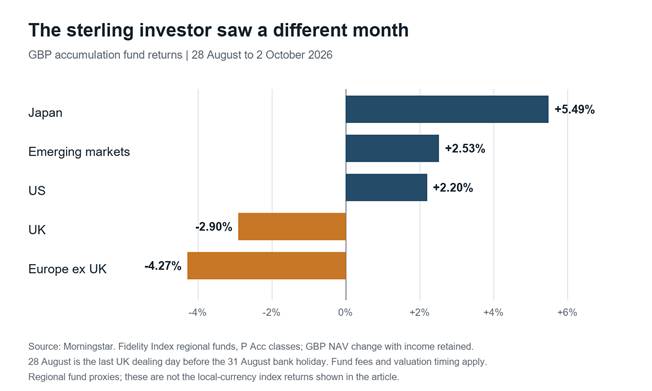
There is always a temptation to blame September itself. It has a reputation for being an awkward month for markets and this one duly obliged, but the more important message was that investors spent much of it adjusting to an economic world which looks stronger than had been expected and therefore rather less conducive to falling interest rates. Global manufacturing strengthened again, the US economy continued to expand at a healthy pace and Europe produced some surprisingly decent business surveys. Even China offered signs that the industrial economy may be stabilising. Much of the impetus continues to come from spending on artificial intelligence, defence, energy and infrastructure, but stronger demand has increasingly been accompanied by rising input costs, while Brent crude above $100 has added another unwelcome inflationary impulse. The problem for markets is relatively simple: stronger growth is good for profits, but once inflation is already above target it is not necessarily good for bonds.
This has left us in a slightly peculiar position as the fourth quarter begins. The economic data are not really telling us to become bearish. Corporate earnings remain strong, the global industrial cycle has improved and investment spending is booming. Yet the price of money has risen substantially and, unlike much of the period following the financial crisis, there is now a perfectly respectable yield available from lending money to the US government, although longer-dated bonds still carry interest-rate risk and sterling investors must also consider the currency. When ten-year Treasury yields are above 5%, equities have to work harder to justify their valuations and new borrowing and refinancing become more expensive. September was therefore less about fears of an imminent recession and more about markets beginning to recognise that interest rates may stay higher for longer than almost anybody expected a year ago.
Two Americas
The contradictions are probably clearest in the United States. For much of September, business surveys and spending data painted a picture of an economy operating at a surprisingly healthy pace, while the extraordinary AI investment cycle continued to support everything from semiconductors and power equipment to construction and data centres. Friday’s employment report, however, told a much softer story. US employers added only 29,000 jobs in September, unemployment edged higher to 4.2% and annual wage growth slowed to 3%. The broader trend is more important than any single monthly number: payroll growth has clearly lost momentum and previous months have been revised lower, even while there remains little evidence of the widespread redundancies normally associated with recession. Participation also ticked higher, suggesting that the rise in unemployment was not simply a story of job losses, although these small monthly movements should not be overinterpreted. The best description still looks like a low-hire, low-fire labour market: companies are reluctant to add workers, but equally reluctant to let good people go.
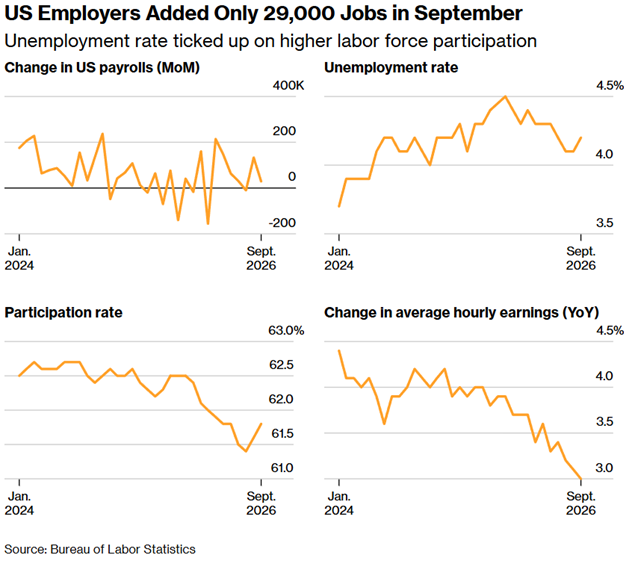
US employment: payrolls, unemployment, participation and wage growth
This feeds directly into the idea of the Two Americas we have discussed before on previous monthly missives. One America owns equities and other financial assets, earns decent interest on savings, benefits from the extraordinary wealth creation surrounding technology and remains perfectly capable of spending. The other is much more exposed to mortgage and credit-card rates, fuel and food prices and the increasing uncertainty around finding a new job if the existing one disappears. It helps explain why economic statistics can appear healthy while public confidence remains miserable, and why the political interpretation of the economy can look very different from the one investors see on their Bloomberg screens. It is also why Friday’s employment report was so interesting for markets: equities initially rose and yields fell because weaker employment reduced the likelihood of another Federal Reserve hike this month. Yet the bond rally proved rather difficult to sustain, suggesting that investors are still more worried about inflation, borrowing and the supply of debt than they are reassured by one softer payroll number.
The spending figures underline the distinction. Real consumer spending rose 0.6% in August, even as real disposable income was unchanged. Inflation also remained above target, at 3.4% on the headline PCE measure and 3.0% excluding food and energy. Softer hiring therefore gives the Fed something to consider, but it does not provide an uncomplicated case for easier policy.
The Bond Market Is Back in Charge
If there is one change in the investment landscape that deserves more attention than almost anything else, it is the re-emergence of the bond market as a genuine constraint on governments, companies and equity valuations. The US ten-year Treasury yield briefly touched 5.34% last week, its highest level in 24 years, and the move increasingly looks broader than a simple repricing of the Federal Reserve. Inflation remains uncomfortable, energy prices are elevated and government borrowing is enormous, while private companies are simultaneously competing for capital to fund one of the largest infrastructure investment cycles in modern economic history. The third quarter rise in Treasury yields has therefore been substantial even as equities have remained remarkably resilient. For all the attention paid to central banks, the more interesting question may be how much of this rise reflects a structurally higher cost of capital, and how much reflects inflation uncertainty and the extra compensation investors now demand for holding long-dated debt.
France offers perhaps the clearest European example of markets rediscovering fiscal discipline. French yields are close to levels not seen since the early 2000s as investors contemplate another difficult budget negotiation, an enormous borrowing requirement and a political system struggling to agree how spending should be brought under control. This is not another euro crisis, and it would be far too dramatic to describe it as one, but the willingness of markets to penalise fiscal uncertainty has clearly increased. The same message is beginning to appear in credit markets, where high-yield spreads have widened from extraordinarily tight levels and investors have started to withdraw money from riskier bond funds. In the US, high-yield spreads widened from 293 to 324 basis points between 25 September and 1 October. That is a meaningful change from a tight starting point, although it does not yet suggest a funding crisis. Corporate balance sheets remain broadly healthy and profits are growing strongly, but 5%-plus government yields create a very different hurdle rate for speculative borrowers than the one they faced only a few years ago.
Europe faces an additional complication. September’s flash inflation estimate rose to 3.8% from 3.2%, with energy prices 18.8% higher than a year earlier. Underlying inflation was lower at 2.5%, but the renewed energy shock makes it harder to assume that weaker US employment will deliver an equally helpful interest-rate backdrop everywhere.
For equities, our view remains fairly straightforward. We are still more concerned about valuation compression than an earnings recession. If profits continue to rise, equity markets can continue to make progress, but investors are becoming less willing to pay almost any price for future growth. Companies with strong balance sheets, visible cash generation and genuine pricing power should be better placed than those whose valuations depend on profits arriving somewhere over the distant horizon. For much of the last decade the answer to almost every valuation objection was that bond yields were extremely low. That argument is no longer available.
AI: The Demand Is Real, but So Is the Bill
Artificial intelligence sits right in the middle of this debate because the evidence for genuine underlying demand continues to be extremely strong. Micron’s latest numbers were another remarkable illustration. Demand for high-bandwidth memory remains constrained by supply and customers are making longer-term commitments to secure capacity. Fiscal fourth-quarter revenue reached $54.2 billion, while operating cash flow of $44.0 billion left $33.2 billion of adjusted free cash flow after net capital expenditure. This is demand already producing cash, although exceptional current margins should not be treated as permanent. Goldman Sachs estimates that the largest US AI hyperscalers are on track to spend around $800 billion on capital expenditure this year, with consensus expectations approaching $1.1 trillion in 2027. These budgets include infrastructure serving wider cloud demand as well as AI. This is increasingly less an AI software story than a global infrastructure cycle involving chips, memory, electrical equipment, cooling, power generation, grid connections and enormous amounts of physical construction.
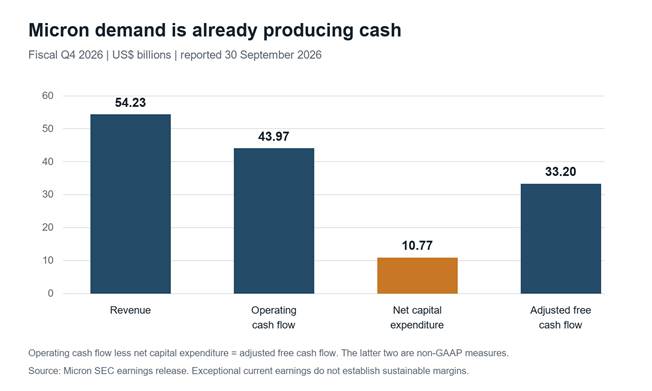
Micron fiscal Q4 2026, ended 3 September; reported 30 September. Net capital expenditure and adjusted free cash flow are non-GAAP measures. Source: Micron earnings release filed with the SEC.
Where we have become more watchful is how all of this is being financed. BIS research found that more than half of the incoming investment deal value in its sample of AI companies between 2021 and 2025 came from other AI companies. Almost half of that AI-to-AI deal value also involved a commercial relationship between the two parties. In other words, the same company can sometimes be investor, supplier and customer within the same ecosystem. There is nothing inherently wrong with that — securing scarce chips or compute capacity can make perfectly good commercial sense — but it makes it more difficult to work out where genuine end-customer demand finishes and industry financing begins. At the same time, the scale of planned capital spending is testing the limits of internally generated cash flow, increasing the use of debt and private credit.
Some of the individual transactions are eye-catching. Anthropic’s planned cloud and infrastructure commitments are measured in the hundreds of billions of dollars. According to IPO documents reported by Reuters, Broadcom has agreed to make up to $42 billion of financing available towards Anthropic’s five-year TPU computing lease commitments of more than $125 billion. Meta’s huge Louisiana data-centre development has also involved tens of billions of dollars of bond financing through a separate investment vehicle. Separate vehicles do not necessarily remove the economic risk: Meta has also provided a capped residual-value guarantee covering the first 16 years of operations. Nvidia has been exploring how its chips themselves might support a much larger market in AI infrastructure lending. Lenders, perhaps sensibly, remain cautious about placing too much value on GPUs whose economic life may be considerably shorter than the physical life of the equipment.
None of this persuades us that the AI boom is about to end. If anything, Micron, Broadcom and the cloud providers continue to show the opposite. What it does tell us is that the next phase will need more evidence. We increasingly want to see utilisation, contracted revenues, cash conversion and real customers paying for AI services, rather than simply ever larger announcements of future capital spending. The comparison with previous technology booms is useful here because genuinely transformative technologies can still attract too much capital in the early stages. Railways transformed the nineteenth century and the internet transformed the twentieth, but neither prevented investors from occasionally paying too much for the infrastructure required to build them. Higher bond yields make that discipline more important, not less.
Iran: Adaptation Without Resolution
The Middle East remains another reason inflation cannot yet be treated as yesterday’s problem. There has been genuine progress in adapting to the disruption around the Strait of Hormuz. LNG shipments improved during September, although the recovery remains from a very low base. S&P Global Energy estimates that even maintaining the faster late-month pace would leave October transits at only around a quarter of pre-war levels. At the same time, the diplomatic picture remains extremely fragile. Iran is still testing a proposed seven-day confidence-building framework, but it is also preparing a significantly harder military response should the United States resume large-scale attacks, while Washington has reinforced its presence in the region. Oil reacted sharply again last week as reports of additional US deployments were combined with concerns over Chinese fuel exports.
Our basic view has not really changed. A possible framework is taking shape, but its substance remains contested. Tehran said on Sunday that current discussions concern Hormuz and denied offering nuclear inspections in exchange for sanctions relief. The sequencing of reciprocal steps remains unresolved. Markets should probably resist trying to forecast every diplomatic twist and concentrate on the economic transmission mechanism. High oil prices eventually feed through into diesel, freight, airline costs and insurance, and from there into inflation and consumer confidence. The danger is less that oil briefly touches another dramatic headline price and more that elevated energy costs persist long enough to influence wage demands, inflation expectations and central-bank policy.
There is also a practical supply response. The G7 has committed to implementing a coordinated 100 million-barrel reserve release over four months, with diesel deliveries brought forward. That takes account of earlier commitments, so it should not all be counted as additional supply. It can cushion the disruption, but it does not restore normal shipping.
China: Stabilising, but Still Waiting for the Consumer
China provided another good example of why better economic data do not automatically produce better markets. Manufacturing surveys improved during September and the technology and export sectors continue to benefit from stronger global investment. The official manufacturing PMI edged up to 50.1 from 49.8, but medium-sized and smaller manufacturers remained below 50. That is an improvement, rather than evidence that the domestic economy has suddenly regained its old momentum. Yet domestic demand remains much less convincing, property is still a drag and consumers remain reluctant to spend with the confidence they displayed during earlier Chinese expansions. Beijing has announced further support, but so far the measures look more like an attempt to ensure the economy meets its growth target than the sort of overwhelming stimulus that would generate a rapid consumer or property revival. That helps explain why Chinese equities performed so poorly in our opening chart despite improving industrial indicators.
The recent Trump-Xi meeting has at least reduced one source of near-term uncertainty. There has been some progress on trade and communication, and both sides appear to recognise the benefits of preventing competition from becoming uncontrolled confrontation. I would still describe this as managed rivalry rather than reconciliation. The strategic competition across semiconductors, AI, defence, energy and supply chains remains firmly in place, but a period of greater predictability would itself be helpful for companies attempting to make long-term investment decisions.
Looking Ahead
There is plenty to keep us occupied this week. In the US, the services ISM on Monday will be worth watching particularly closely after the strength of the manufacturing data, while Wednesday’s Federal Reserve minutes should reveal how comfortable policymakers really were with September’s first rate increase in three years. Friday’s jobs report has significantly reduced the probability of another increase at the October meeting, but the Fed has not declared victory over inflation and a December move remains very much in play. Weekly jobless claims on Thursday should help us decide whether the weak payroll number really was another step down in labour demand or whether the low-hire, low-fire description still holds, while Friday’s University of Michigan consumer survey will provide another useful reading on the Two Americas theme, particularly around inflation expectations and the impact of higher fuel prices.
The third-quarter earnings season is also beginning to stir, with PepsiCo and Delta among the larger companies reporting before the banks begin the process more seriously the following week. We will be watching less for the headline earnings numbers than for what companies say about borrowing costs, consumer behaviour and capital spending. As the major technology companies report later this month, the most important question will be whether hyperscalers are still increasing AI capital-expenditure budgets and, equally importantly, whether the revenue and cash flows generated by that spending are beginning to catch up. After several years in which ever-larger capex announcements were treated automatically as good news, markets may increasingly ask how those projects are being financed and who ultimately pays for them.
Away from America, Brazil votes today, with Lula and Flávio Bolsonaro heading into a first round which polls suggest is unlikely to settle the contest and may instead lead to a very close runoff on 25 October. Markets will be interested less in the personalities than in what the result implies for fiscal policy in a country where high interest rates are already putting considerable pressure on households and government finances. Japan also deserves attention next week, with the Reuters Tankan and Thursday’s Fast Retailing results offering a useful read on how companies are coping with higher energy costs and a weak yen following the Bank of Japan’s latest rate increase. France will meanwhile continue its budget negotiations under the increasingly watchful eye of the bond market.
Above all, we will continue watching the same three things that shaped September: bond yields, oil and AI spending. A sustained fall in Treasury yields would give equity valuations some breathing room, meaningful diplomatic progress with Iran could quickly change the inflation outlook, and continued evidence that AI demand is translating into real revenues would justify much of the investment boom. Equally, another move higher in yields, a renewed escalation in the Gulf or signs that AI financing is becoming more dependent on debt and vendor support would make life rather more uncomfortable.
September therefore leaves us in an unusual but not necessarily bearish position. Growth has been stronger than expected, earnings remain good and there is still little evidence of a broad economic downturn, but the cost of capital has risen sharply and markets are beginning to rediscover the concept of price. We continue to think earnings can trump macro concerns, although investors will probably need to be rather more selective about what they are prepared to pay for those earnings. Bull markets have always climbed a wall of worry and, as we enter the final quarter of the year, there is certainly no shortage of wall.
For now, though, we are out of September, but not out of the woods.
DOWNLOADS
There are currently no downloads associated with this article.