
Market Matters – The Price of Tomorrow
What a fortnight. A dramatic change at the top of the world’s most influential semiconductor company, an approaching flotation of almost unimaginable proportions, renewed inflation worries and another lurch upwards in bond yields. Yet look at the scorecard and the extraordinary thing is how little the headline equity indices have moved. The S&P 500 has been treading water in dollar terms since early August and ended the past fortnight slightly higher in sterling. Behind that apparent calm, however, individual shares and entire industries have been thrown around with considerable force.
It is tempting to see every unsettling headline as evidence that the artificial intelligence boom is about to end. I am not convinced. The earnings backdrop is improving, valuations have become less demanding and investors appear to be broadening their horizons beyond the most celebrated technology businesses. That does not mean the risks have gone away. It means the market may be starting to separate the promise of a revolutionary technology from the price it is prepared to pay for that promise.
The man behind the machine
Jensen Huang’s resignation from Nvidia has understandably dominated the financial news. Finance chief Colette Kress takes over on an interim basis while the board looks for a permanent successor. For 33 years he has been the company’s architect, champion and public face, pursuing accelerated computing long before the world understood its potential. When an individual becomes so closely identified with a business, their sudden departure is bound to provoke difficult questions. Can Nvidia maintain its culture, retain customers and execute with the same speed? This week’s results will be scrutinised as much for management’s reassurances as for the numbers.
The most obvious historical parallel is Steve Jobs. When Jobs stepped aside at Apple in August 2011, shortly before his death, many feared that the company’s best years were behind it. Yet Tim Cook, sometimes dismissed as an operator rather than a visionary, went on to build a vastly larger and more profitable enterprise. Apple had a succession plan and appointed Cook immediately. Nvidia is still looking for a permanent successor. Even so, the comparison reminds us that an extraordinary founder can leave behind an extraordinary organisation. Its capabilities need not disappear with the individual who created them.
Nvidia retains its engineers, the CUDA software ecosystem, advanced networking technology and deeply embedded relationships with customers spending enormous sums on computing infrastructure. Those advantages will not be replicated overnight. A leadership transition still brings genuine risks, especially in a competitive industry where pace and judgement matter enormously. But how much has the underlying value of Nvidia changed, compared with the market’s confidence in that value? In my humble opinion, the answer could prove encouraging for patient investors.
An extraordinary amount of noise, remarkably little direction
The accompanying chart tells the story more effectively than almost any headline. Between 30 October and 13 November, the S&P 500 gained 1.13% in sterling total-return terms, the FTSE 100 rose 1.84% and Europe excluding the UK advanced 3.17%. China managed a gain of 1.82%, while Japan, despite some alarming daily declines, finished down just 1.39%. These are not the returns one might expect after two weeks containing such extraordinary events. In US-dollar price terms, the S&P 500 gained 2.5% in the week to 13 November, despite the sharp fall in Nvidia’s shares.
The calm, however, is an illusion created by aggregation. Since early August, healthcare and consumer staples have advanced strongly, while communication services, industrials and important parts of the semiconductor complex have struggled. There have been equally violent differences within technology itself. In the week to 13 November, Nvidia fell 12.8% in dollar price terms, while AMD rose 18.9% and Broadcom gained 18.2%. The market is no longer moving as a single AI trade. Some businesses are being rewarded for dependable earnings, others punished for high expectations and fragile financing assumptions. This is rotation, not universal capitulation. And it may be healthier than another narrow advance driven by a handful of familiar names.
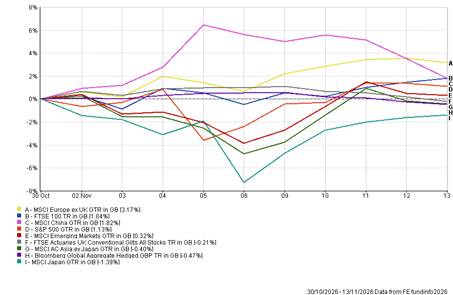
Figure 1. Selected equity and bond indices, 30 October–13 November 2026. Cumulative total returns in sterling. The equity series reinvest gross dividends. The Bloomberg Global Aggregate series is hedged to sterling. Data from FE fundinfo.
Who pays for tomorrow?
Nvidia’s leadership upheaval arrives as Anthropic prepares for an extraordinary stock-market flotation, with an implied valuation of up to $1.4 trillion on a fully diluted basis. Reports of heavy demand reveal how strongly investors believe in the future commercial adoption of AI. Yet a successful IPO tells us something about the appetite for growth, rather than proving what the ultimate returns on today’s investment will be.
Alongside the flotation, Anthropic has agreed a $26 billion private placement, including $10 billion from Nvidia. The placement depends on the IPO completing and other conditions being met. Some of the companies building the infrastructure are also helping to finance the businesses that use it.
CoreWeave’s latest results illustrate the other side of the ledger. Quarterly revenue reached $3.66 billion and operating profit was $207 million, but net interest expense amounted to $846 million and the company reported a $709 million net loss. Demand is hardly the problem. The challenge is that electricity, equipment, construction and financing costs arrive long before returns become certain. A revolutionary technology does not automatically make every company financing it a good investment.
We remain constructive on the broader supply chain, particularly advanced semiconductors, memory and networking. But the market is quite properly asking which companies can translate exceptional demand into sustainable cash generation. That may be the defining investment question of the next phase of the AI cycle.
The earnings story refuses to cooperate with the bears
Corporate America continues to produce remarkably strong results. With 91% of S&P 500 companies having reported third-quarter earnings, 84% have exceeded expectations, comfortably above the five-year average of 78%. In aggregate, reported earnings were 3.1% above estimates, admittedly well below the five-year average of 7.5%. Nevertheless, the breadth of positive results is impressive, and analysts have been raising estimates at a time when they would normally be cutting them.
Since the end of September, the aggregate forecast for fourth-quarter earnings has increased 1.1%, while 58% of companies issuing guidance have been positive, against a five-year average of 40%. Longer-term estimates are also moving higher, with Yardeni Research putting consensus S&P 500 operating earnings for 2027 at around $427 per share. More revealingly, the three Magnificent Seven companies that missed estimates this quarter fell 7.8% on average from two trading days before to two trading days after their results, compared with 1.1% for S&P 500 companies that missed overall. Perhaps they are finally asking not simply whether profits will grow, but whether that growth justifies the price of the shares.
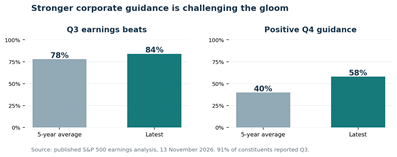
Figure 2. S&P 500 earnings beats and positive guidance against five-year averages. Of companies that had reported Q3 earnings, 84% beat estimates, against 78% historically. Of the 78 companies that had issued Q4 earnings guidance, 45 were positive, or 58%, against 40% historically. Data from FactSet Earnings Insight, 13 November 2026.
Valuations are doing some of the work
The lack of index progress has concealed a significant change in valuations. Yardeni Research puts the S&P 500’s forward price-to-earnings multiple at around 18 times. On the same basis, the forward multiple on the S&P 500 Growth index has fallen from 26 times at the start of the year to 19, about one multiple point above the S&P 500 Value index. With analysts upgrading profits while share prices struggle to advance, valuations have become appreciably less demanding.
That is encouraging, though earnings forecasts can still prove wrong. For the moment, the evidence points more towards a repricing of expectations than a fundamental collapse in corporate profitability.
Inflation returns to the conversation
The latest American inflation releases are the uncomfortable counterweight to the earnings optimism. Headline consumer prices rose 0.4% in October and core prices rose 0.3%, both month on month and both above expectations. Producer prices for final demand rose 0.3% on the month and 6.5% over the year, the highest annual rate since November 2022. Both headline monthly readings slowed from September. The ten-year Treasury yield finished Friday at 5.15%, and markets have priced in more Fed tightening. Higher borrowing costs are particularly awkward when so much of the AI investment cycle is being financed today against profits expected tomorrow.
There is, however, a more reassuring detail. Almost all of the week’s rise in ten-year yields came from higher real yields. Ten-year breakeven inflation, a market-based measure, ended Friday at 2.24%. Credit markets have become more discriminating about heavily indebted AI borrowers, but there is little evidence yet of widespread corporate funding stress. Broad US high-yield spreads actually narrowed from 342 to 320 basis points between 6 and 12 November, the latest available reading at publication. A more selective attitude towards new projects may be useful discipline, provided the Fed does not push financial conditions too far.
Britain’s growth picks up
For once, the latest economic news from Britain deserves rather more attention than the customary gloomy commentary. GDP expanded by 0.7% in the third quarter, accelerating from 0.5% in the second and marking the strongest quarterly growth since early 2024. September was the surprise. Output rose 0.2% on the month, against expectations of no growth. The economy is now 1.9% larger than a year earlier. Services, which account for most British output, grew 0.9%, with particularly strong contributions from business-facing activities. Even GDP per head increased 0.7% over the quarter, a welcome indication that the improvement was not simply a function of population growth.
There is an appealing connection with our wider theme. Output in computer programming, consultancy and related activities grew 4.4% in the quarter. The ONS found that many of the firms reporting the strongest turnover growth were involved in AI and cloud computing. Naturally, we should not get carried away. Construction contracted 0.7%, business investment grew just 0.4%, half the rate economists had expected, and inflation still constrains the Bank of England. Nevertheless, in my humble opinion, these figures challenge the familiar assumption that Britain is condemned to permanent stagnation. Stronger services activity would be an encouraging foundation on which to build, particularly if it feeds through to higher productivity.
Europe keeps growing
Across the Channel, Eurostat’s latest estimate puts euro-area growth at 0.4% in the third quarter, down from 0.6% in the second, with annual growth at 1.3%. The picture is uneven: Spain grew 0.6%, Germany managed 0.2%, France contracted 0.1% and Italy was unchanged. German manufacturing orders rebounded 4.4% in September after a 10.1% fall in August, leaving orders just 0.2% higher over the quarter. It is a modest sign of stabilisation.
European equities have nevertheless proved relatively resilient. Our chart shows Europe excluding the UK outperforming the S&P 500 in sterling over the fortnight. Its different sector mix may have helped. Their appeal need not depend on matching America’s growth rate: less demanding valuations and a broader range of corporate beneficiaries may prove valuable while investors reassess the price of future earnings.
Asia and commodities: quieter signals beneath the noise
Japanese shares rebounded sharply in the latest week after the previous week’s sell-off, leaving Japan down 1.39% over the fortnight in sterling total-return terms. Chinese and emerging-market performance has been mixed. Elsewhere, oil fell for a second week, agricultural prices were below their summer highs and copper had retreated from its recent peak, offering a tentative counterweight to the worrying US inflation releases. Financial markets are sending conflicting messages, which makes it dangerous to treat any single day’s dramatic move as a verdict on the global outlook.
Looking ahead
The coming week offers little prospect of boredom. Nvidia reports on Tuesday 17 November, the same day as US retail sales and industrial production. The Fed publishes its October meeting minutes on Wednesday, and Anthropic is expected to begin trading on Nasdaq on Thursday. Several central-bank speeches are also scheduled. The two technology events will probably attract the most attention, but the bond market may prove equally important in determining how investors respond.
I remain cautiously optimistic. The AI buildout will encounter disappointments, the occasional excess and perhaps some painful failures. Equally, much of the technology is already demonstrating real commercial value, and the benefits will not be confined to the companies manufacturing the hardware. Investors are increasingly questioning the price of the AI revolution, but perhaps they are beginning to rediscover the value of the businesses that stand to benefit from it. The opportunity may ultimately be much broader than the original excitement suggested.
The great irony of the AI revolution is that a technology promising an extraordinary improvement in productivity may add to price pressures as it is built, long before those gains arrive. Investors remain convinced by the destination. The difficulty, as ever, is finding out how expensive the journey will be.
DOWNLOADS
There are currently no downloads associated with this article.