
Market Matters – When Markets Lose Patience
Overview
It was an uncomfortable week for investors, especially those exposed to technology companies. Tuesday’s decisive Democratic victory in the US midterm elections initially brought relief, but Wednesday’s rally gave way to a ferocious reversal on Thursday. The Nasdaq 100 dropped 6.4%, wiping some $2.3 trillion from its value in a single session. Friday brought a welcome, if incomplete, recovery. The S&P 500 still finished the week 2.7% lower in US-dollar price terms, while the Nasdaq 100 remained more than 10% below its October high.
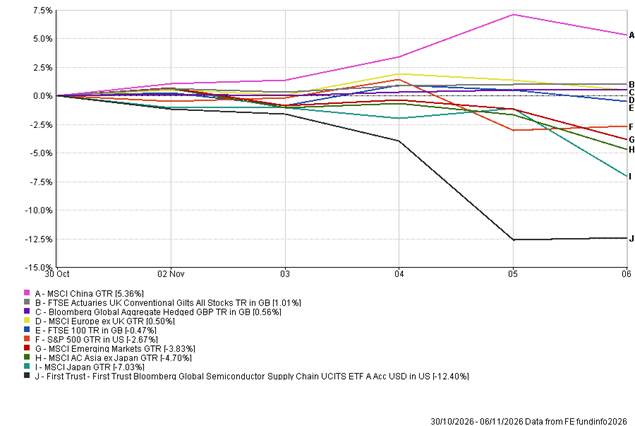
The chart reveals the divergence beneath the headlines. The global semiconductor supply-chain fell 12.4% in US dollars over the period, Japanese equities lost 7.0% and Asia excluding Japan declined 4.7%. Yet Chinese equities rose 5.4% and UK conventional gilts gained 1.0%. This was not a uniform retreat from every asset. It was a particularly violent reassessment of areas where enthusiasm, positioning and expectations had become closely intertwined.
Sudden corrections shake the confidence of investors who were comfortable holding the same businesses a week earlier. But it is worth asking what has actually changed. The economic data have improved, corporate earnings remain exceptional and the latest productivity figures suggest that something rather encouraging may be happening beneath the market noise. The events of this week look more like a painful resetting of expectations than the end of the longer-term growth story.
US Politics – A Blue Wave and New Incentives
The Democrats’ sweeping midterm victory, giving them control of both the House and Senate from January, was largely a verdict on the cost of living, energy prices and the direction of the administration. A divided Washington may then make some of President Trump’s more contentious policies harder to pursue, although it would be premature to assume that political gridlock automatically produces calmer markets. Of greater immediate relevance to technology investors has been the growing political resistance to the sheer scale of the AI infrastructure program.
As the saying attributed to Charlie Munger goes, ‘Show me the incentive and I will show you the outcome.’ It seems a particularly appropriate observation given the growing political resistance to data centres. For technology executives, the incentive is to secure the computing capacity they believe will underpin the next great wave of economic growth. For households worried about electricity bills, or communities concerned about water supplies, the calculation is rather different. Yet there is another side to this story. In Louisiana, the construction of Meta’s enormous data centre has generated such a windfall in local tax revenues that some schoolteachers received sales-tax distributions exceeding $50,000 this June, compared with around $10,000 in 2025. That is a rather wonderful illustration of how these investments can transform local communities when the benefits are shared. Meanwhile, Texas’s incoming governor has called for a moratorium on new data centres until stronger protections are introduced, following the permitting halt already ordered by Republican Governor Greg Abbott in September. None of this suggests that the infrastructure will not be built, but perhaps it will need to be built more thoughtfully, with greater consideration for local communities and a fairer distribution of the economic rewards.
US Earnings – A Rather Different Picture
The contrast with corporate results is striking. With 88% of S&P 500 companies having reported, 84% have beaten earnings expectations and aggregate third-quarter earnings are growing by 31.4% compared with a year ago !! Revenue growth stands at 14.3%, and all eleven sectors are reporting increases in both sales and profits. These growth figures combine reported results with estimates for companies yet to report. If the earnings figure is sustained, this will be the third consecutive quarter of growth exceeding 25%. It is difficult to square those numbers with the idea that the US corporate sector is suddenly running into serious trouble.
There are qualifications. In aggregate, reported earnings are just 2.7% above estimates, against a five-year average surprise of 7.5% across completed reporting seasons, suggesting that much good news was already expected. Even so, fourth-quarter earnings are forecast to grow by another 28.4%, and the forward market valuation has fallen to 17.7 times earnings, below its five- and ten-year averages. It would be unwise to treat an earnings forecast as a promise, but the present correction is taking place against a background of genuine profit growth, rather than a current deterioration in aggregate earnings.
Artificial Intelligence – The Price of Impatience
Concern that a Democratic sweep could slow the construction of data centres and increase scrutiny of AI-related investment helped trigger Thursday’s sell-off. That worry fell on a market already questioning the size and financing of the spending commitments being made. Some infrastructure providers have become increasingly dependent on debt, expensive capital and assumptions about future utilisation. Selling by fast-money and systematic investors appears to have amplified the move as prices broke through important technical levels. This helps explain the violence of the correction, although it does not make the underlying questions any less legitimate.
It is important not to confuse the demand for AI with the economics of building everything required to supply it. The evidence from advanced semiconductors, high-bandwidth memory and cloud computing continues to indicate powerful demand. AMD illustrated the distinction this week: data-centre revenue rose 97% year on year, yet quarterly free cash flow fell to $554 million from $1.53 billion a year earlier. Strong demand does not automatically translate into stronger cash generation. But demand does not guarantee that every data-centre operator, chip supplier or lender will earn an attractive return. Grid connections, planning approvals, energy costs and the price of financing will influence which projects proceed and who benefits. Indeed, a more measured pace of construction might ultimately improve the capital discipline of the largest technology companies, even if it is disappointing for suppliers whose shares had been priced for uninterrupted expansion.
Time horizons also matter. Chief executives can justify these investments by looking five or ten years ahead, and in many cases their businesses have the balance sheets to do precisely that. Capital markets have nevertheless remained open: Microsoft issued $25 billion of notes this week and Meta completed a $15 billion dollar bond issue. That supports their ability to invest, while leaving the question of returns on that investment unresolved. Financial markets, meanwhile, can become impatient after a disappointing quarter, a financing announcement or an adverse political headline. We have always believed that the AI opportunity would be accompanied by periods of indigestion. It would be surprising if an investment programme of this scale proceeded without mistakes, delays or occasional excesses. The next phase may favour those who turn spending into cash flow, better services and sustainable profits.
Productivity – The More Encouraging Story
Possibly the most important release of the week received much less attention than the equity market rout. US non-farm business productivity increased at an annualised rate of 3.6% in the third quarter, as output rose while hours worked barely changed. Unit labour costs fell at an annualised rate of 0.7%. More importantly, productivity has advanced at an annualised rate of 2.2% during the current business cycle, compared with just 1.5% in the previous cycle. It is too early to know how much of this can be attributed to artificial intelligence, but it is precisely the kind of improvement we have been looking for.
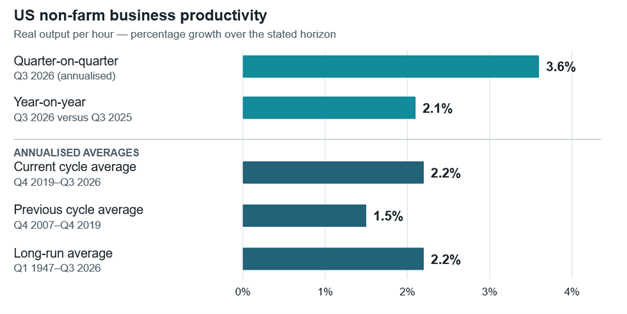
US non-farm business productivity: real output per hour, percentage growth. Q3 2026 quarter-on-quarter growth is seasonally adjusted and annualised; year-on-year growth compares Q3 2026 with Q3 2025. Cycle and long-run averages are annualised over the dates shown. Source: US Bureau of Labor Statistics, preliminary release, 5 November 2026.
Productivity can seem a rather dry economic concept, yet over time it is one of the principal sources of rising living standards and corporate profitability. When businesses are able to produce more with the same resources, they have greater scope to raise wages, protect margins and expand without generating equivalent inflationary pressure. This is why I remain optimistic about the longer-term consequences of AI adoption, even if the infrastructure boom is proving more expensive and untidy than some expected. It is perfectly possible for investors to have overpaid for certain parts of a technological revolution while the revolution itself goes on to create considerable economic value.
The US Economy – Still Showing Resilience
Friday’s employment report reinforced the positive side of the ledger. The economy added 165,000 jobs in October, well ahead of expectations, unemployment edged down to 4.1% and earlier months were revised higher. Preliminary consumer sentiment also improved, from 48 to 51, although confidence remains subdued and cost-of-living concerns are still widespread. Encouragingly, households’ expectations for inflation over the next year eased from 4.7% to 4.3%. The survey was conducted before the election and Thursday’s sell-off. None of this removes the Federal Reserve’s dilemma: the economy is proving resilient, but high energy prices and lingering inflation mean that further tightening remains possible. Stronger productivity, if sustained, could eventually make that balancing act considerably easier.
UK – Growth Remains the Missing Ingredient
The Bank of England increased Bank Rate by a quarter of a percentage point to 4% on Thursday, with eight members supporting the move and one preferring a larger rise. The Bank now expects inflation to reach around 5% by the middle of next year, largely because of the effects of higher energy costs. That forecast uses energy-price assumptions ending on 27 October, before this week’s sharp fall in oil. The October Budget provided some near-term relief for household energy bills, but it did little to alter the underlying constraint on UK policymaking: weak productivity and limited fiscal headroom make it difficult to stimulate growth without raising concerns about inflation or borrowing.
The fiscal outlook is therefore uncomfortable rather than disastrous. The government has sought to preserve credibility and gilt markets have been relatively orderly, but the OBR’s forecast of just 1% real GDP growth in 2027 leaves little room for disappointment. Britain would benefit enormously from the same sort of sustained improvement in business efficiency that appears to be emerging in the United States. Without that, the argument over taxes, spending and interest rates risks becoming a continuing debate about how to divide an economy that is not growing quickly enough.
Europe and Asia – A More Mixed Picture
Inflation is also complicating matters in Europe. Euro-area consumer prices were an estimated 4.0% higher than a year earlier in October, with energy once again the main culprit, while Germany’s industrial recovery remains fragile. European markets have generally avoided the most extreme US technology valuations, but higher financing costs and a hesitant industrial backdrop are hardly ideal. Across Asia, the semiconductor-heavy markets were particularly vulnerable to Thursday’s change in sentiment, even though the underlying demand for advanced memory remains strong. The China-Japan divergence in our chart reminds us that global equities are not responding to a single story.
Bonds, Oil and the Wider Picture
Government bonds offered some protection during Thursday’s rush for safety, although the stronger US jobs report subsequently pushed Treasury yields higher. Oil prices fell over the week as investors considered whether the US election result might eventually encourage a change in approach towards Iran, but disruption to shipping and the risk of renewed escalation have hardly disappeared. The direction of energy prices is particularly important: a sustained retreat would ease pressure on households, company margins and central banks, while another spike would threaten to undo some of the progress being made on inflation. In an already nervous market, the bond and oil markets will continue to deserve close attention.
This week…
US consumer-price figures on Tuesday and producer prices on Friday will provide the next tests of the market’s nerves, alongside developments in Washington and the debate over future data-centre approvals. I would not be surprised to see further volatility. After a sell-off of this magnitude, investors often need time to rebuild confidence, and some companies will have to work harder to justify the expectations previously embedded in their valuations. Time will tell whether last week’s turbulence proves to be a brief interruption or the beginning of a more prolonged period of consolidation.
For now, though, I see more grounds for encouragement than despair. Companies are earning more, the American economy continues to create jobs and the productivity numbers are moving in the right direction. Above all, the technological advances that should support economic growth and corporate earnings over the coming years have not been undone by a few difficult trading sessions. Markets will always alternate between enthusiasm and doubt, sometimes with remarkable speed. The important thing is to avoid allowing the intensity of the moment to obscure the direction of travel. Patience may be uncomfortable after a week like this, but it remains one of the qualities most likely to be rewarded over time.
DOWNLOADS
There are currently no downloads associated with this article.